




ATEN AP212
x 120W Power Amplifier with DSP
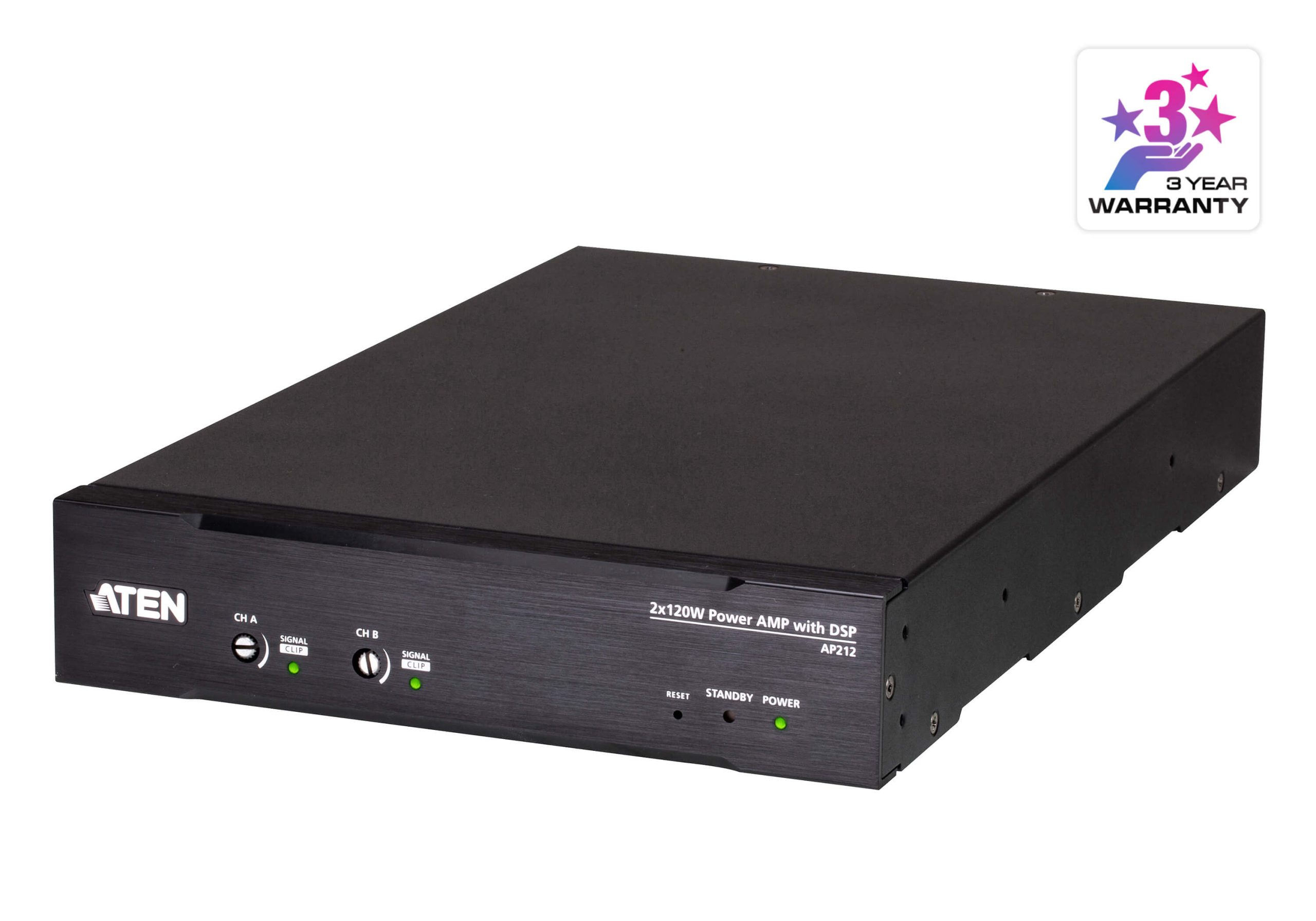
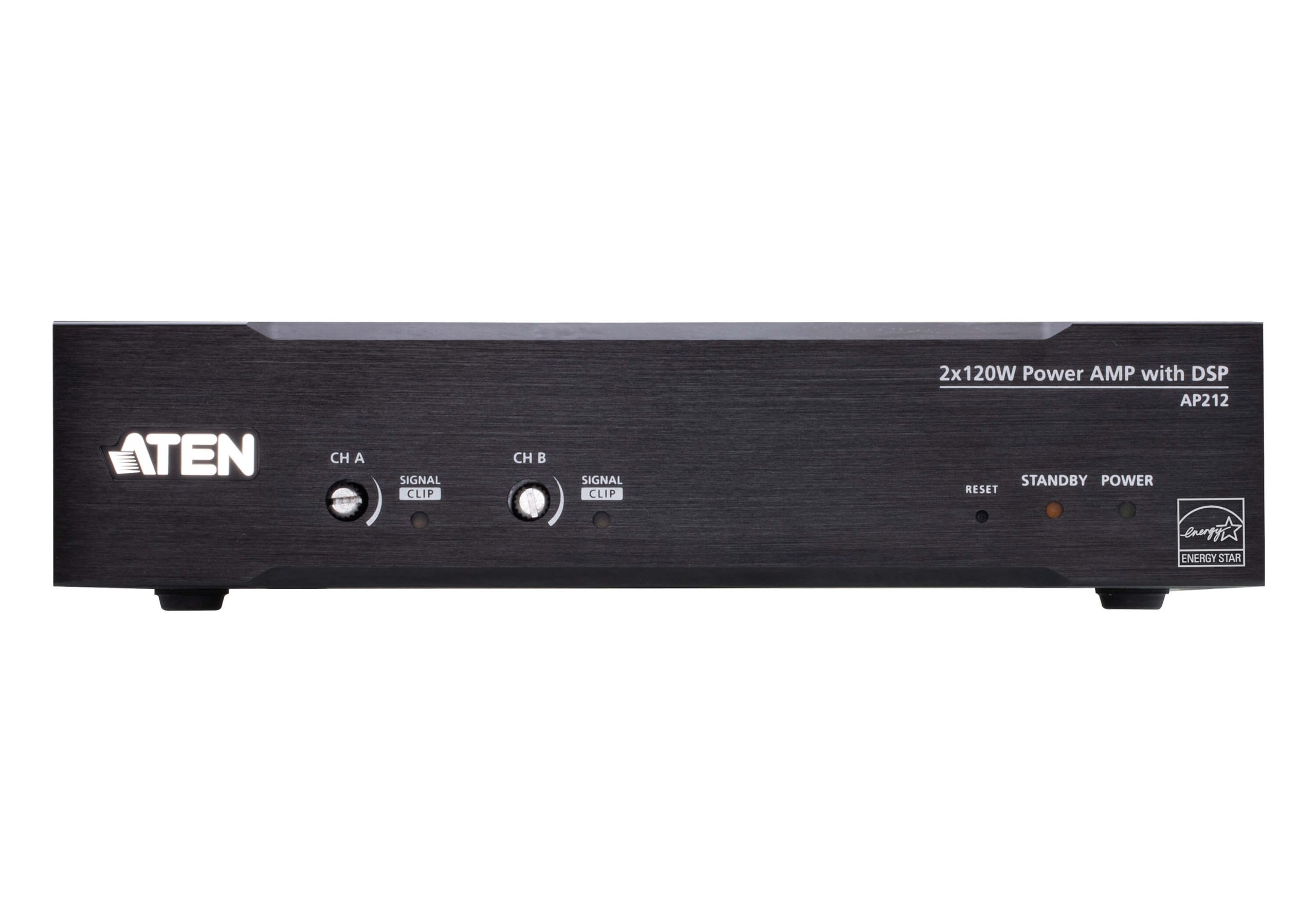
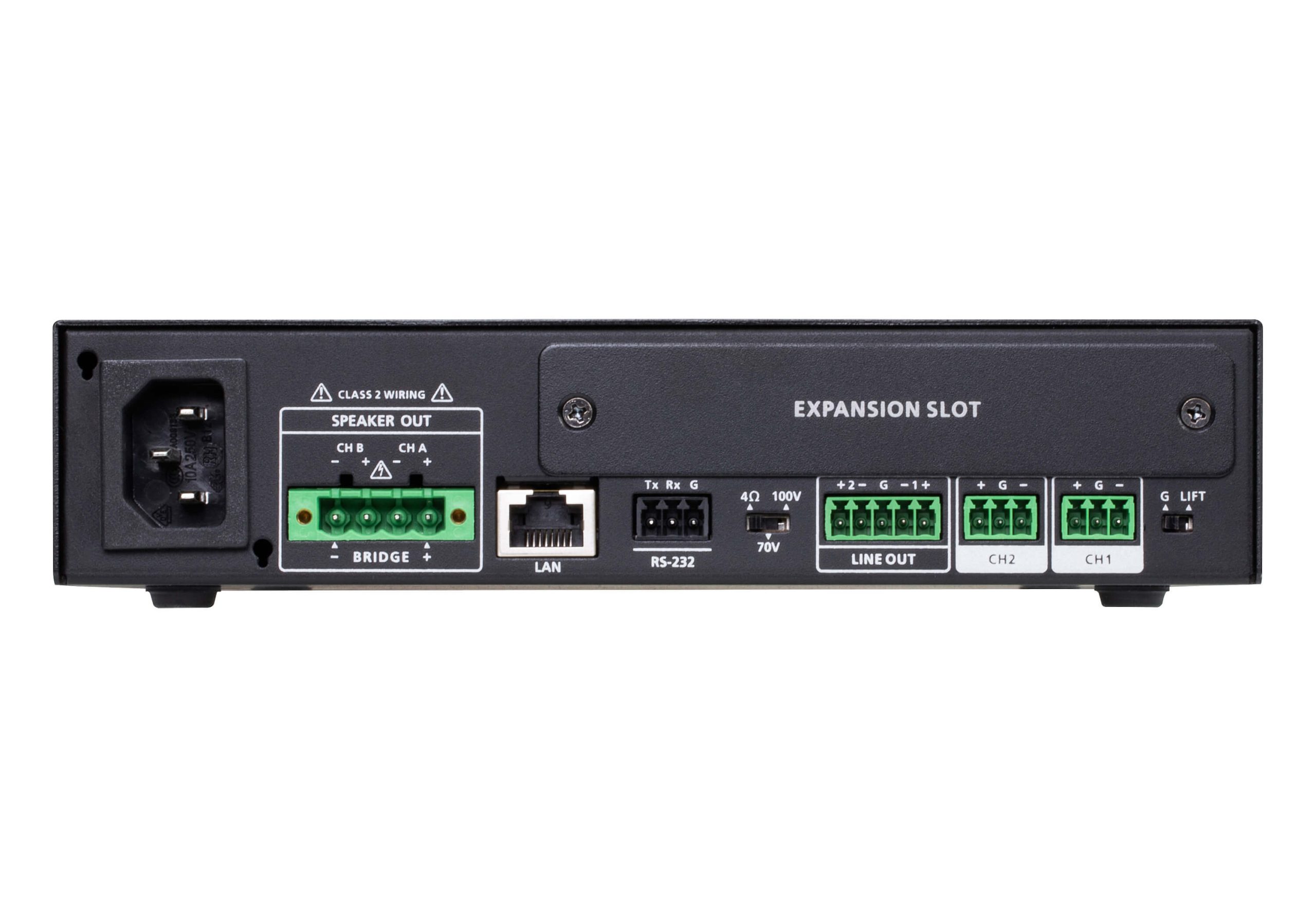
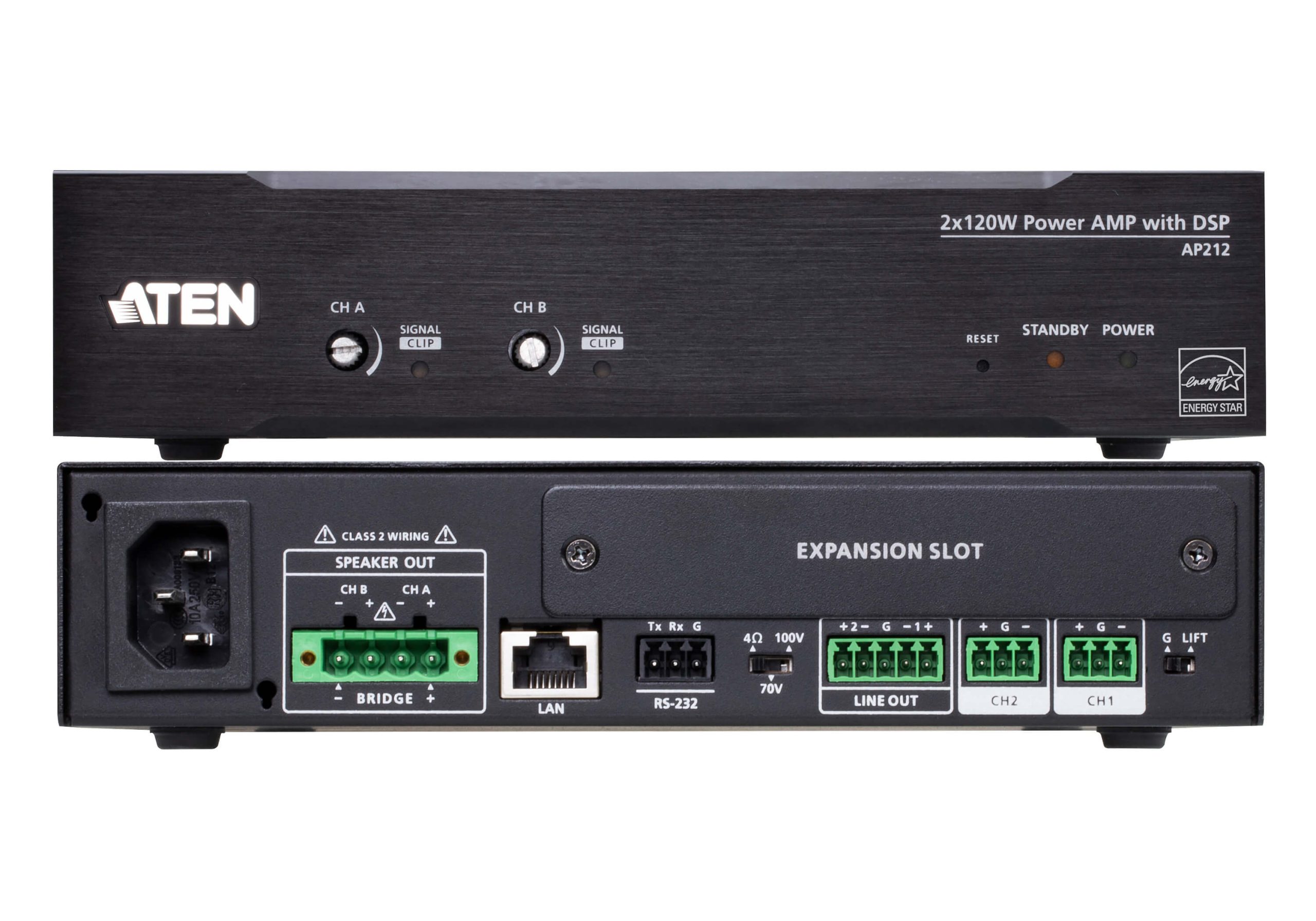
ATEN AP212 is a dual-channel DSP-equipped amplifier that delivers 120 W per channel in a compact enclosure. The support for balanced / unbalanced line level inputs and the capability of driving 4 ohm low impedance or 70/100V line (in Bridge mode) loudspeaker systems have made AP212 suit a wide range of public address applications. Configurable through an intuitive WebGUI, the built-in DSP allows Speaker EQ, 5-band EQ, delay, limiter, and up to 20 presets for precise tuning and extensive audio system protection purposes. Ground lift is deployed to eliminate unwanted hum noises from power circuit. Immersive sound experience is delivered with no compromise on power efficiency thanks to the amplifier’s Class-D design and ENERGY STAR qualification, conserving energy while lowering operational costs. Customizable Auto Standby mode enables the AP212 to automatically switch to “sleep” when the signal level comes lower than -40 / -50 dBu for 10 / 15 / 25 minutes.
Speaking of the system protection circuit, the AP212, along with the speakers connected to it, are prevented from damages led by shorted outputs, over / under-voltage, high frequency overload, and overtemperature. Plus, the amplifier will be muted when the heat sink temperature exceeds the limit. The fanless design avoids fan noise and prevents dust from building up inside the chassis.
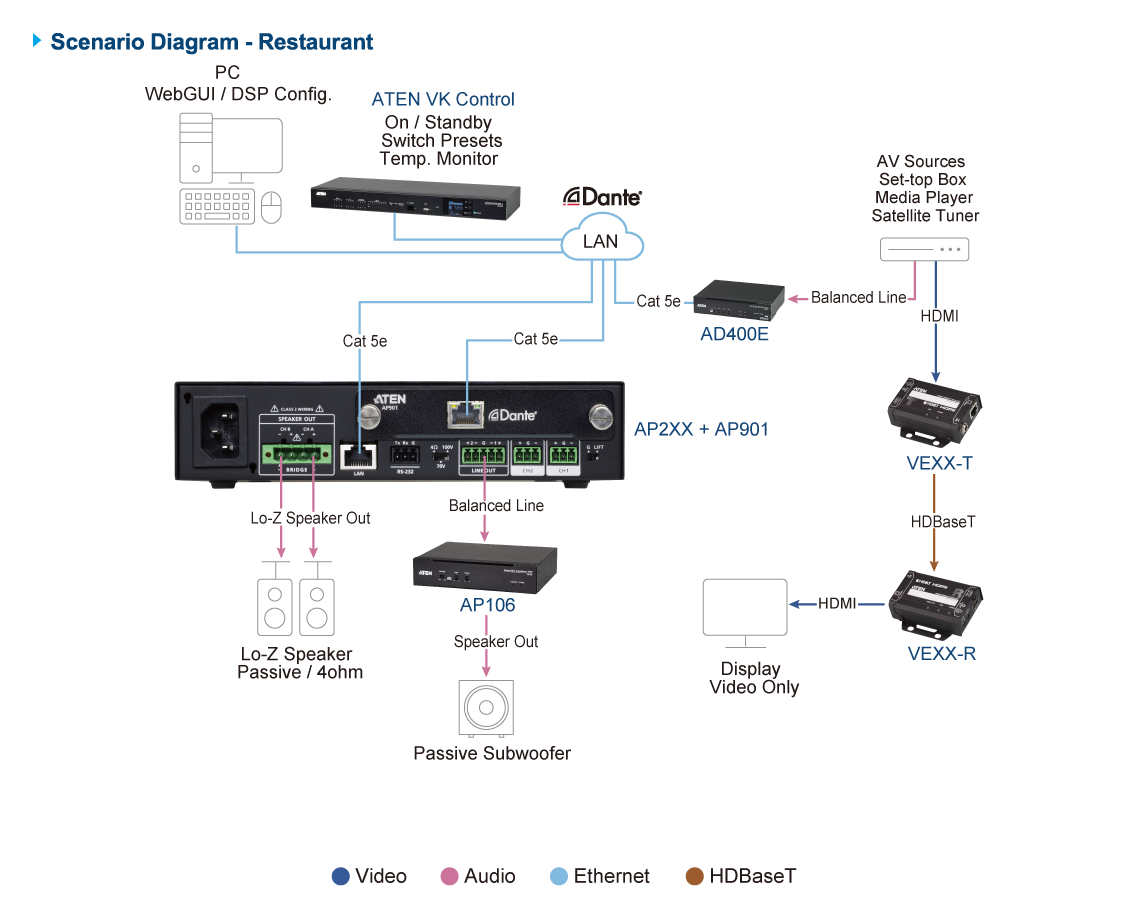
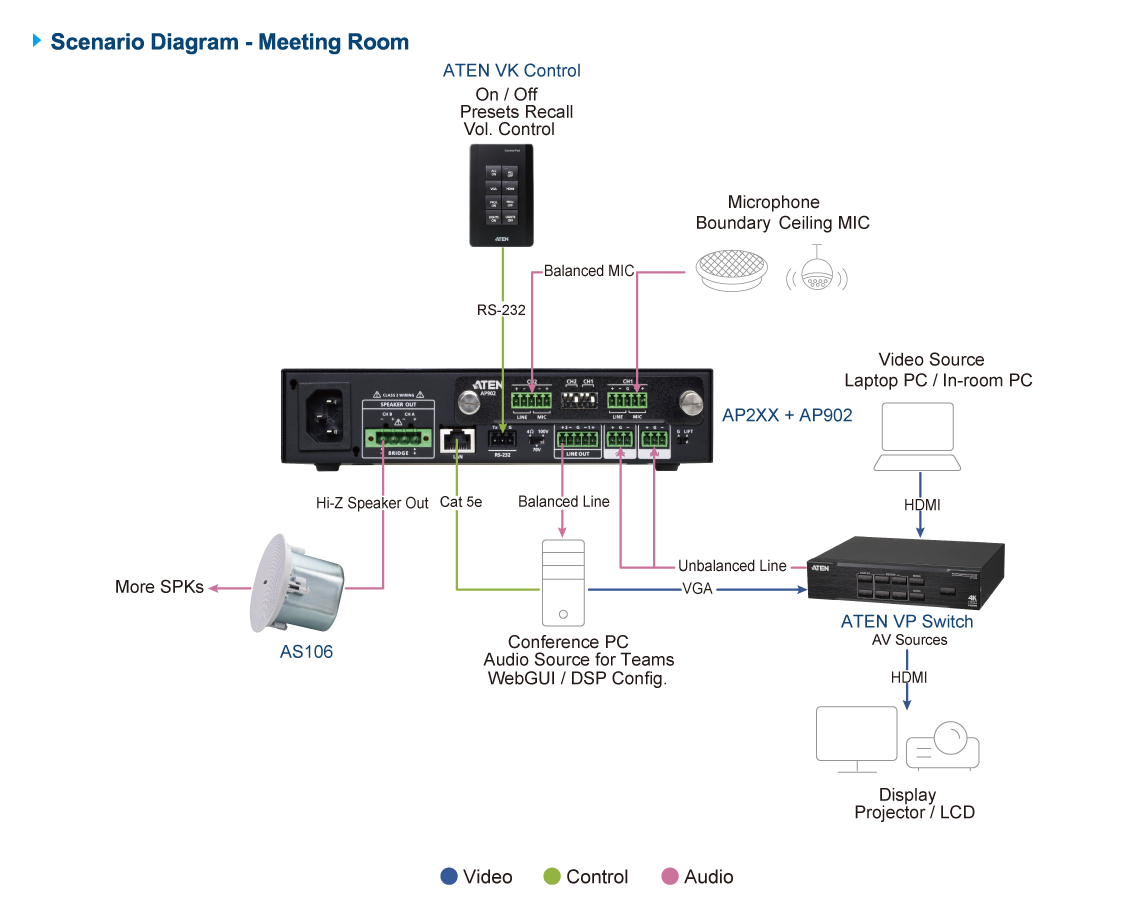
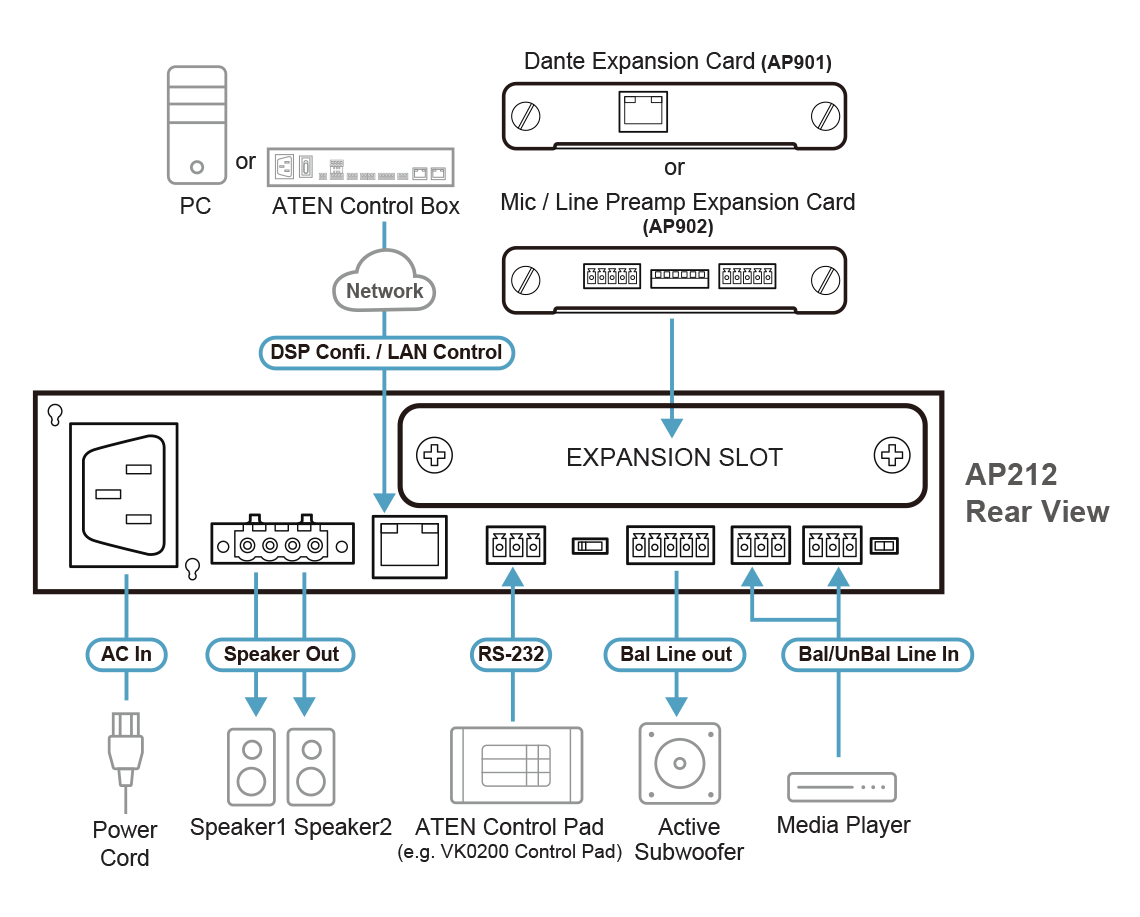
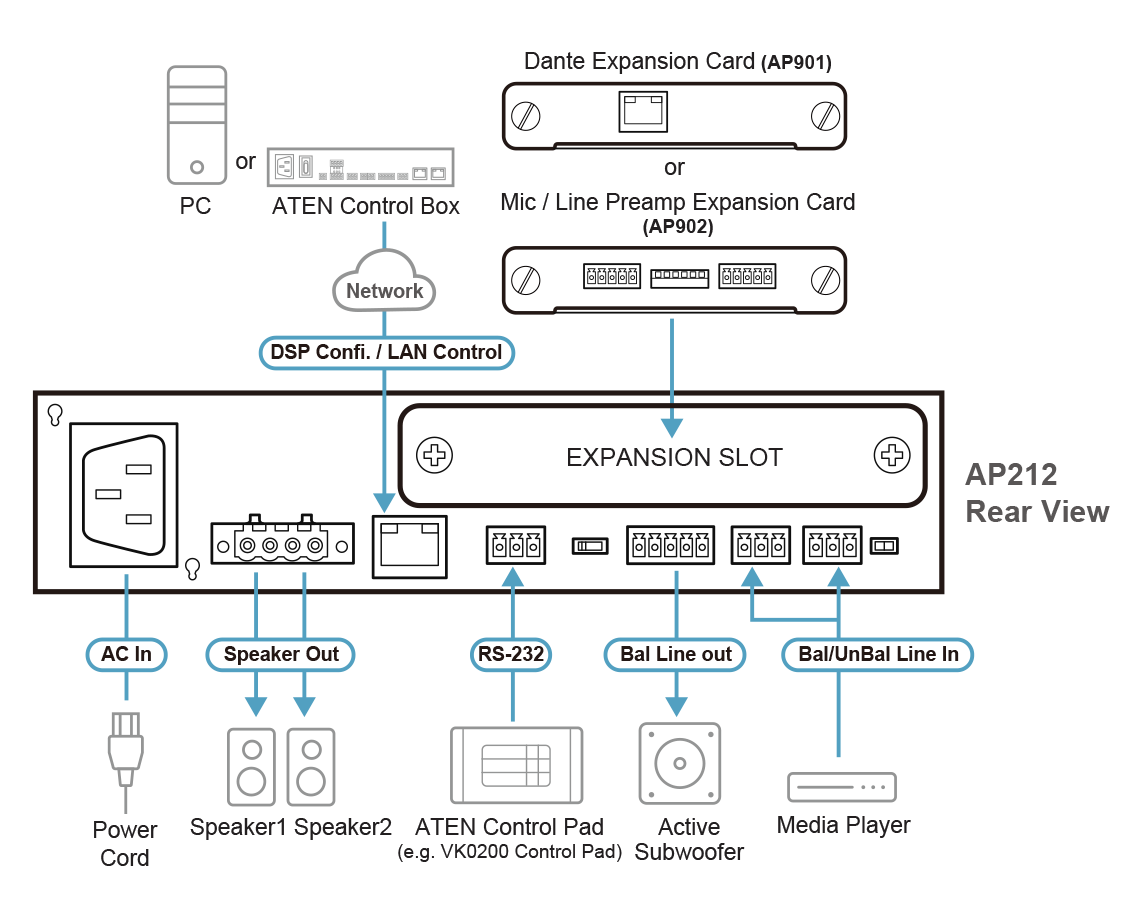
Engineered to deliver the ultimate flexibility, the AP212 features an expansion slot for plugging in AP901 2-CH Dante Expansion Card to make the sound system compatible with Dante network or AP902 2-CH Mic/Line Pre-AMP Expansion Card to receive two channels of mic / line input signals. The amplifier can also be integrated with VK Control System via RS-232 and Ethernet connection for comprehensive control even from a distance. Mounting hardware is available for rack or surface-mounting depending on the installation needs. With a rich set of features, the AP212 assures reliable amplification with professional audio quality and high power efficiency for any enterprise-grade applications that require high quality sound reinforcement and distribution.
Diagram
Spesification
| System Specification | |
| Rated Power | 120Wrms / 240Wpeak per Channel @4Ω 240Wrms / 480Wpeak @70/100V Under Bridge Mode |
| Distortion | THD+N: <0.1%, 1kHz, 3dB before clipping |
| Frequency Response | 50~20kHz, +/-3dB @4Ω, 1W |
| Sensitivity | Balanced: +4dBu Unbalanced: -10dBV (0dBu=0.775Vrms, 0dBV=1Vrms) |
| Amplifier Type | Class D |
| Audio Inputs | |
| Interfaces | 2 x 3-pin 3.5mm Euroblock (Bal/Unbal Line In) |
| Impedance | Balanced: 20kΩ / Unbalanced: 10kΩ |
| Detect Threshold | -50dBu |
| Audio Outputs | |
| Interfaces | Line Output: 1 x 5-pin 3.5mm Euroblock Speaker Output: 1 x 4-pin 5.08mm Euroblock |
| Impedance | Lo-Z: 4Ω / Hi-Z: 70V (20Ω), 100V (40Ω) Line Output: 600Ω |
| Audio Effects | Built-In DSP |
| Protection | Output Shortcut AMP Output over/under voltage High Frequency Overload Thermal Protect |
| Communication | |
| RS-232 | Connector: 3-pin, 3.5mm, Terminal Block Baud rate and protocol: Baud Rate: 19200, Data Bits: 8, Stop Bits:1, Parity: No, Flow Control: No |
| Compliance | |
| Certification | FCC, CE, UKCA |
| Power | |
| Maximum Input Power Rating | 100-240V~, 50/60Hz, 4A with PFC |
| Power Consumption | AC110V:41.9W:196BTU AC220V:39.6W:186BTU |
| Environmental | |
| Operating Temperature | 0~50℃ |
| Humidity | 0-80% RH, Non-Condensing |
| Storage Temperature | -20~60℃ |
| Physical Properties | |
| Weight | 2.15 kg ( 4.74 lb ) |
| Housing | Metal |
| Dimensions (L x W x H) | 20.00 x 32.30 x 4.40 cm (7.87 x 12.72 x 1.73 in.) |
| Note | For some of rack mount products, please note that the standard physical dimensions of WxDxH are expressed using a LxWxH format. |